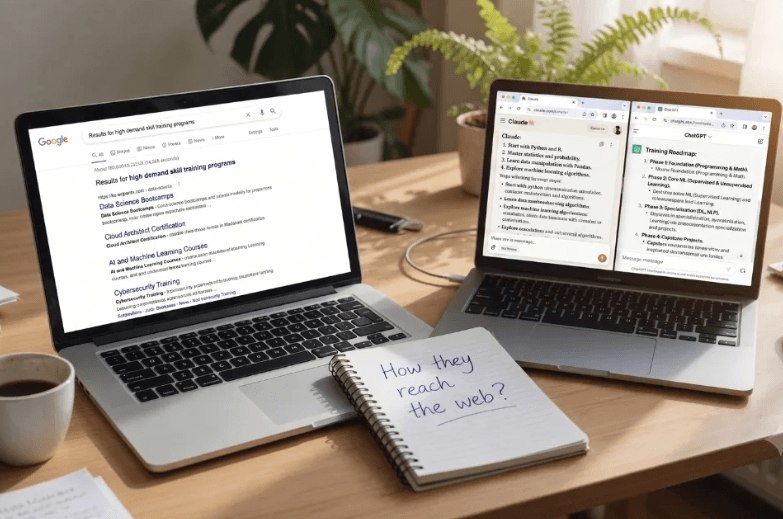
Searching for information has undergone a significant transformation in the last couple of years. Traditional search engines have always been the answer to finding an answer, but they have led users to search through dozens of links and find information that is not reliable. A deep search AI assistant stands out as the game-changer in today’s search revolution, delivering research-informed, contextually relevant, and direct answers rather than just web pages.
AI is revolutionizing search technology, making it more efficient for both business professionals and students, researchers and marketers.AI-powered search tools are making searches more efficient and better for researchers, marketers, and business professionals alike. Let’s delve into the reasons why a deep search AI assistant is the new trend over conventional search.
Deep Search AI Assistant
Advanced AI and natural language processing (NLP) and machine learning are integrated into a deep search AI assistant, which helps to comprehend complex queries and provide detailed responses. It doesn’t just match keywords as traditional search engines do, it can consider intent, collect information from a variety of trusted sources, and then present organized insights.
A deep search AI search assistant can summarize the findings, identify trends, and even reference sources to boost the credibility of the result, as opposed to showing the user a list of different websites to compare.
How Traditional Search is Falling Short.
While traditional search engines are still useful when browsing websites, they do have a number of drawbacks:
- Users need to open lots of pages for getting correct information.
- Sometimes, the search results contain duplicate or low-quality information.
- Searches based on keywords might not reflect the user’s search intent.
- It is very time consuming to compare information from several sources.
These constraints can hinder productivity and pose risks of missing out on crucial information for researchers and businesses making strategic decisions.
The advantage of AI Search Results.The benefit of AI search results.
This is the difference between a simple search AI assistant and a deep search AI assistant. It comprehends the purpose and intention of a question and provides purposeful answers to information gathered from a variety of sources.
A few benefits are:
Faster Research
Users don’t need to read through dozens of articles; they’re given the answer to their questions in a shortened format in seconds. This substantially cuts down study time, yet provides high quality results.
Better Context Understanding
A deep search AI search assistant will comprehend the follow-up queries and keep its memory of the conversation so that users can investigate the subject in a natural manner without repeating the same information.
Smarter Information Analysis
AI is not just about showing you individual web pages, it’s about pulling information from multiple sources, finding patterns and providing balanced insights.
The emergence of the Web AI Agent.The advent of the Web AI Agent.
One of the other significant improvements is the Web AI agent. These smart-agents can actually surf around websites, compare data, summarize long reports and even research automatically without any human involvement, as opposed to search assistants.
For instance, rather than answering several questions regarding industry trends, a web AI agent collects information, sorts it out, and generates a report in a structured format, with little or no human input.
This is particularly useful for professionals who have to deal with a lot of information on a daily basis.
AI in Market Research is transforming business decisions.
Market research is a crucial component of business decision-making, and AI’s role in providing accurate information is increasingly becoming a valuable tool for businesses.
AI research tools assist organizations in the following ways:
- Monitor industry trends
- Analyze competitor strategies
- Track consumer behavior
- Identify emerging opportunities
- Summarize market reports
Automating a significant amount of the research process will allow companies to concentrate on strategy and less on manual data collection.
AI Market Analysis Tool for Smarter Insights
An AI market analysis tool is a solution that can turn raw data into actionable insights for businesses. Rather than sifting through spreadsheets, reports and news articles manually, AI can scan large volumes of data to identify patterns that might not be apparent.
These tools can help to determine what customers want, predict market trends and analyse competition performance much quicker than conventional research techniques.
Market analysis is becoming more data-driven, efficient, and accurate as businesses are continuing to adopt AI.
A Strong Perplexity AI Alternative
There are also a lot of users who are looking for advanced AI research tools, and they are looking for a reliable Perplexity AI alternative. Perplexity AI’s ability to engage in conversational search is a feature, while newer AI assistants add the capacity for more in-depth web research, customisable workflow, improved document analysis, and improved integration with business applications.
The selection of the right AI search solution depends on the specific requirements and objectives of each user, but there are several options available, allowing for greater flexibility, cost-effectiveness, and advanced research features.
See also: Advantages and Disadvantages of Technology
Future of AI-Powered Search
As AI continues its development, search will become more and more conversational, personalized, and intelligent. Instead of just delivering search results, AI assistants of the future will be research partners capable of comprehending goals, checking information and offering customized recommendations.
Today, companies using AI search technology enjoy quicker decision-making, more productivity, and accurate insights.
Conclusion
A deep search AI assistant transforms the search experience into something much superior, providing faster, more accurate and context-aware information. Whether you’re doing research for academic purposes, analyzing the markets, or exploring new business ideas, AI-powered search assistants make research efficient.
They transform information search and discovery, from being a powerful deep search AI search assistant to a capable web AI agent. In addition to being a revolutionary AI market analysis tool, AI search assistants can be used as an AI market research solution, an AI market research tool, and even an alternative to Perplexity AI.