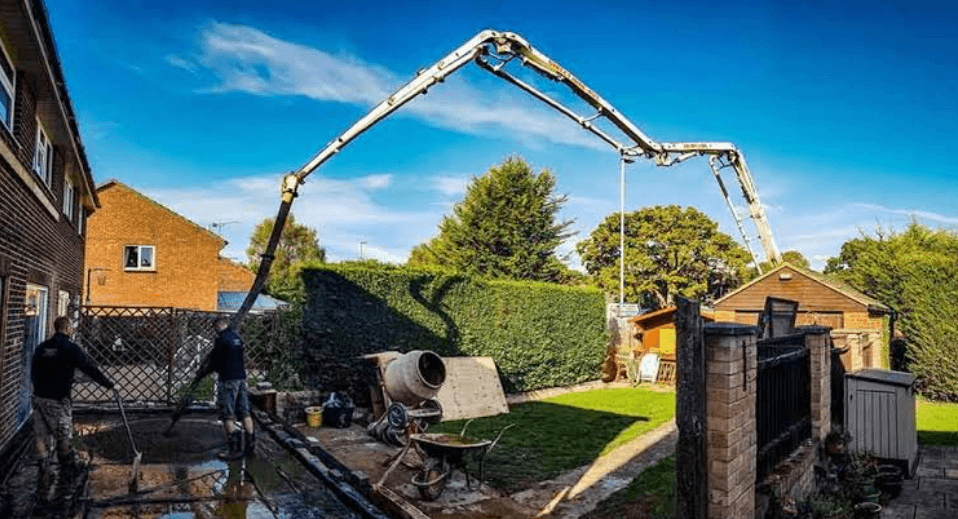
Boom pumps working in the UK range from around 20 metres at the smallest end to just over 60 metres on the largest machines in the national fleet. A 36-metre pump handles most domestic and mid-size commercial pours, which is why it appears on more sites than any other size.
The figure attached to a pump describes its vertical reach, measured from the truck rather than from the edge of your site. Horizontal reach always falls several metres short of that number, and no boom delivers maximum height and maximum distance at the same time. Understanding that gap before arranging concrete boom pump hire saves a wasted day and a machine that cannot reach the pour.
How Far Can Different Boom Sizes Reach?
Pump sizes cluster into recognisable classes, each suited to a particular kind of work. Matching the class to the job matters more than securing the largest machine available.
The sizes commonly hired across the UK break down as follows:
- 20m to 24m: Domestic extensions, garage bases, and small slabs. These machines fit down residential streets where larger trucks cannot turn.
- 28m to 32m: Larger foundations and two- or three-storey work. Horizontal reach sits around 24 to 28 metres, which covers most suburban plots from the roadside.
- 36m to 42m: The commercial workhorse. Suits mid-rise pours, larger rafts, and any site where the pump must clear a building to reach the far side.
- 47m to 52m: High-rise construction and long horizontal spans across open sites. Setup requires considerable space for the outriggers.
- 58m to 62m: The largest pumps operating in Britain are reserved for major structural work where nothing smaller can place the concrete.
Most jobs are booked one class larger than necessary. The additional reach is charged from the moment the pump leaves the yard, whether or not the boom ever extends that far.
Why Height and Distance Cannot Both Be Maximum?
The advertised figure and the reach available on site are rarely the same number. Three mechanisms account for the difference, and all three apply to every pour.
The Arc of the Boom
A boom achieves maximum vertical reach with its sections stacked close to vertical. Extending outward drops the tip along a curve, trading height for distance with every metre gained.
Picture the boom tracing an arc through the air. Full height sits at the top of that arc, full horizontal reach sits at the bottom, and every position between the two represents a compromise. A pump reaching 30 metres up and 20 metres out is working well within its rating on both axes at once.
Clearance Over Obstacles
A boom passing over a roof, a wall, or a row of trees spends part of its reach on the clearance itself. What remains is the horizontal distance available on the far side.
Clearing a two-storey house consumes roughly eight metres of vertical reach before the boom starts travelling toward the pour. Contractors who measure only the ground distance to their pour point consistently underestimate the machine they need, and they discover it on the morning of the pour rather than during planning.
Truck’s Position
Reach is measured from the pedestal, so the standing position of the lorry sets the origin of every calculation. Anything that pushes the truck further back reduces the reach at the far end by the same amount.
Parked cars, skips, narrow carriageways, weak ground, and street furniture all move the truck away from the site. A pump that would comfortably serve the pour from the kerb may fall short when forced to stand two properties down the road.
5 Site Conditions That Limit the Boom Pump Reach
Reach on paper assumes ideal conditions. Real sites impose limits that appear nowhere in a manufacturer’s specification sheet.
Five conditions affect what a boom can achieve on the day:
Outrigger Footprint
Booms deploy on outriggers that spread the load and stabilise the truck. Larger machines demand six to nine metres of width when fully extended, and a boom cannot be raised until they are set. Narrow streets and short driveways rule out certain sizes entirely.
Ground Bearing Capacity
Outriggers concentrate an enormous load through a small footprint. Soft verges, unmade ground, drainage covers, and basement vaults all require spreader pads, and some ground is simply unsuitable. The assessment happens before the pump arrives, not after.
Overhead Power Lines
Booms operate within statutory exclusion zones around overhead cables. A line crossing the approach to a site can prohibit a pour that would otherwise be straightforward, regardless of the reach available.
Boom Fold Type
Z-fold booms unfold upward and need clear headroom to open. RZ-fold booms unfold in a tighter envelope, which allows them to operate under low bridges, beneath overhanging structures, and inside restricted courtyards. The distinction matters more on urban sites than raw reach does.
Access Route and Parking Suspension
Getting the truck to its standing position is a separate problem from reaching the pour. Weight restrictions, one-way systems, and parking suspensions all require planning. Pro-Mix Concrete operators work across every London borough and know which streets take a boom pump and which require a smaller machine, which is a question worth settling before the concrete is ordered rather than after.
How to Work Out the Reach You Need?
Calculating reach takes ten minutes with a tape measure and a photograph. Guessing takes a day and costs a wasted hire.
Work through these five steps before you call the supplier:
- Identify where the truck can realistically stand, taking into account parking, access width, and ground condition
- Measure the horizontal distance from that position to the furthest point of the pour
- Identify the highest obstacle between the two, whether a roof, a wall, or a tree line
- Add clearance above that obstacle, then add the height of the pour itself
- Check the outrigger width against the available road or hardstanding
Send the supplier a photograph of the frontage alongside those measurements. Any competent pump operator will specify the machine from that information in a single phone call, and arranging concrete boom pump hire on that basis removes almost every risk of a machine arriving that cannot do the work.
Important FAQs
What is the difference between vertical and horizontal reach on a boom pump?
Vertical reach measures the height at which a boom places concrete, and it names the machine. Horizontal reach measures distance across the ground and typically runs three to five metres shorter, since extended booms support more of their own weight.
How much space does a concrete boom pump need to set up?
Smaller pumps deploy outriggers across roughly four to six metres. Larger machines require six to nine metres of stable ground. The boom cannot be raised until the outriggers are fully extended and properly supported.
Can a boom pump reach over a house?
Boom pumps routinely clear two-storey houses to place concrete in rear gardens. Clearing the roof consumes around eight metres of reach, so measure the total distance and height rather than the ground distance alone.
What size boom pump do I need for a two-storey extension?
A 24- to 32-metre pump handles most two-storey extensions comfortably, provided the truck can stand near the frontage. Restricted access or a long rear garden usually pushes the requirement toward a 36-metre machine.
How long does a boom pump take to set up and pack down?
Setup generally takes twenty to thirty minutes, with a similar period for washing out and folding down afterwards. Hire charges begin on arrival rather than at the first cubic metre, so setup time forms part of the cost.
Conclusion
Three numbers decide whether a boom pump reaches your pour. The name on the machine tells you how high it goes, the horizontal figure is always a few metres less, and both are counted from wherever the truck parks rather than from your site. Check where the lorry can stand, work out what the boom has to clear along the way, and make sure the outriggers fit the road. A smaller pump in the right spot beats a bigger one parked two doors down every time.
Pro-Mix Concrete has supplied concrete and pumping across London for over twenty years, sending the mix and the machine together so the grade, the slump, and the boom all suit one another. Their crews know which streets take a full-size truck and which need something smaller.
Give experts the street, the standing position, and the pour height. One call settles the reach, the access, and the concrete boom pump hire together.
Read More: How Much Do Concrete Suppliers in London Charge Per Cubic Metre