Looking for a Montessori preschool near me can feel overwhelming, but finding a program that matches your child’s curiosity and need for independence doesn’t have to be. A good local Montessori preschool will focus on hands-on learning, mixed-age classrooms, and trained guides who support your child’s natural development—so prioritize those features when you search.
You’ll learn how Montessori classrooms differ from typical preschools, why those differences matter for early development, and what to look for in nearby programs so you can compare options with confidence. Expect practical tips on evaluating classrooms, questions to ask during tours, and signs a program truly follows Montessori principles.
Core Montessori Principles in Early Childhood
These Montessori principles prioritize your child’s independence, hands-on learning, and a classroom organized to support concentration and self-directed progress. Expect specific practices that promote fine motor skills, practical life tasks, and gradual introduction of abstract concepts.
Child-Centered Learning Approach
You guide learning by observing your child’s interests, then offering materials that match their developmental readiness. Teachers act as facilitators: they give brief, targeted demonstrations and step back so your child can repeat and master activities at their own pace.
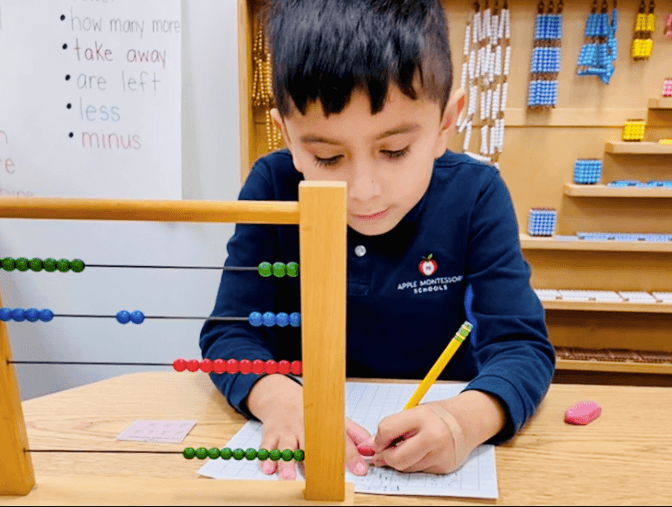
Learning focuses on concrete materials—counting beads for math, sandpaper letters for literacy—that let your child manipulate real objects before moving to symbols. This sequence builds deep understanding and reduces frustration when concepts become abstract.
You’ll notice mixed-age groups in classrooms, which let younger children model skills from older peers and older children reinforce knowledge by teaching. This social structure supports leadership, empathy, and individualized progress without competitive grading.
Developmentally Appropriate Activities
Activities align with your child’s sensitive periods—windows when they are naturally receptive to certain skills like language, order, or movement. Teachers present tasks that match those windows so your child develops quickly and with confidence.
Practical life exercises (pouring, buttoning) strengthen coordination and independence while preparing your child for academic work. Sensorial materials (graded cylinders, color tablets) refine perception and vocabulary through repeated, self-correcting exploration.
Curriculum progresses from concrete to abstract: manipulatives for counting precede written numerals; tactile letter work precedes spelling. Your child advances by mastery, not seat time, and assessments come from observation and work plates rather than tests.
Role of the Prepared Environment
A prepared environment gives your child accessible, orderly materials arranged on low shelves to encourage independent choice. Each item has a clear purpose, a logical sequence, and a designated place to promote responsibility and concentration.
Furniture suits child size, and activities are grouped by area: practical life, sensorial, math, language, and cultural subjects. Clear visual organization and minimal distractions let your child focus for longer uninterrupted periods.
Teachers maintain calm routines and rotate materials based on observation to match emerging interests. You’ll see a balance of freedom and structure: children choose work freely but within consistent classroom rules that support safe, productive exploration.
See also: Private Knee Replacement Surgery Canada Cost: Comprehensive Price Breakdown and What to Expect
Benefits of Local Montessori Education
Choosing a nearby Montessori preschool gives you access to an education model that emphasizes independence, hands-on learning, and close partnerships with families. Expect focused social skills development, tailored academic pacing, and meaningful community involvement that directly affect your child’s daily experience.
Social and Emotional Growth
You’ll see your child develop practical self-regulation through routines and classroom roles. Montessori classrooms use mixed-age groups, so your child practices empathy, leadership, and conflict resolution while working alongside younger and older peers.
Teachers guide social interactions with concrete tools: turn-taking activities, grace-and-courtesy lessons, and conflict-mediation steps. Those practices help your child move from impulsive reactions to calm problem-solving in predictable ways.
The environment itself supports emotional growth. Low shelves, child-sized materials, and consistent schedules reduce stress, while real responsibilities—caring for plants, preparing snacks—build confidence and a sense of belonging.
Individualized Academic Progress
You’ll notice lessons tailored to your child’s current development rather than a fixed grade-level pace. Teachers observe and record mastery, then introduce materials when your child shows readiness, which accelerates learning in areas like early literacy and numeracy.
Montessori materials offer multisensory, sequential experiences. For example, sandpaper letters link touch, sight, and sound for letter recognition; golden beads move from concrete counting to abstract place-value concepts. This reduces gaps and supports sustained progress.
Your child benefits from uninterrupted work periods that allow deep focus. Those blocks help build concentration, intrinsic motivation, and the ability to complete multi-step tasks—skills that translate into smoother transitions to elementary classrooms.
Family and Community Engagement
Local Montessori schools often structure regular parent-teacher observations and workshops so you can understand daily methods and reinforce them at home. You’ll find scheduled observation windows, parent education nights, and take-home learning suggestions that align with classroom practices.
Community ties matter: many preschools partner with nearby libraries, parks, and local artisans for field trips and service projects. Those partnerships expose your child to neighborhood resources and teach civic awareness through direct experience.
You also gain a network of families who share expectations about independence and respectful behavior. That consistency between home and school reinforces routines, reduces confusion for your child, and makes collaborative problem-solving with teachers straightforward.