
Every few months a new injectable shows up promising to be “the next big GLP-1,” and every few months I have to remind myself that a press release is not a peer-reviewed trial. Survodutide is different in one respect: the pitch actually has an interesting engineering idea behind it, not just a bigger number chasing a headline. So let’s do this properly. What’s the hype, what does the data actually support, and what’s the honest grade once you strip out the marketing gloss.
The Hype
The hype, boiled down: survodutide is a molecule that hits two hormone receptors instead of one, GLP-1 and glucagon, and the promise is that this combination does something neither hormone manages solo. It’s being talked about as a weight-loss drug and, quietly, as maybe the more interesting liver drug of the two. Boehringer Ingelheim, the company running the trials, has it in Phase 3 for obesity and for fatty liver disease, with regulatory fast-track badges attached. That’s the sales pitch. Now let’s check the receipts.
What’s Actually in the Bottle (Mechanistically Speaking)
Your body already runs this dual system without any help from a lab. GLP-1 is the “I’m full, slow down” signal released from your gut after eating: it dulls appetite, slows stomach emptying, nudges the pancreas to release insulin appropriately. It’s the ingredient that made semaglutide and liraglutide into household names, because turning up that one signal alone reliably gets people to eat less.
Glucagon is the more misunderstood half of the pair. Most people know it only as “the hormone that raises blood sugar,” which sounds like the last thing you’d want in a weight drug. But glucagon also revs up energy expenditure and acts directly on the liver to help clear fat stored there. The catch, and it’s a real one, is that you have to dose it carefully, because push it too hard and you’re fighting your own blood sugar control [P5].
Survodutide (still sometimes labeled by its development code, BI 456906) is built to hit both receptors in one molecule [P5]. GLP-1 supplies the appetite brake. Glucagon is supposed to supply a metabolic push and a liver cleanup crew. It’s a genuinely clever design brief. Whether the drug delivers on the brief is the actual review.
It’s given as a once-weekly injection, titrated up slowly over weeks rather than dosed at full strength immediately [P1]. That’s not a gentle-onboarding marketing flourish, it’s damage control: GI side effects in this drug class hit hardest when the dose jumps, so the slow ramp is there to keep people on the drug rather than throwing up their way off it.
Grading the Evidence, Trial by Trial
Appetite arm: does it make people eat less? Yes, convincingly. In a Phase 2 dose-finding trial of 387 adults with a BMI of 27 or higher, no diabetes, weight loss was dose-dependent, topping out around 18.7% for people who reached and held the 4.8 mg dose over 46 weeks [P4]. That’s a real number, not a rounding trick.
But here’s the part the highlight reel skips: adverse events hit about 91% of survodutide participants versus 75% on placebo, and GI complaints specifically hit roughly 75% versus 42% [P4]. Ninety-one percent is not a footnote, it’s most of the room. This isn’t unique to survodutide, it’s the going rate for the whole GLP-1 category, but “well-tolerated” is not the phrase I’d reach for.
Liver arm: does the glucagon half actually clean house? Yes, and this is the genuinely good part. In a Phase 2 MASH trial of 293 patients with biopsy-confirmed fibrosis stages F1 through F3, published in the New England Journal of Medicine in 2024, MASH improved without worsening fibrosis in 47%, 62%, and 43% of patients across the 2.4, 4.8, and 6.0 mg groups, versus 14% on placebo. Liver fat dropped by at least 30% in 63%, 67%, and 57%, versus 14% on placebo [P2]. Those are strong, dose-responsive numbers, and they’re the clearest evidence that the glucagon half of the molecule isn’t just along for the ride.
The honest caveat, because a review that only quotes the good numbers isn’t a review: fibrosis improvement, the actual scarring that predicts long-term liver trouble, came in at 34%, 36%, and 34% versus 22% on placebo [P2]. Real, but modest. The drug clears fat with real conviction. Whether that translates into undoing scar tissue is a slower, harder question that Phase 2 simply couldn’t answer, which is exactly why bigger, longer trials exist.
Phase 3, the graduation exam. SYNCHRONIZE-1 (NCT06066515) put 726 adults across 116 sites in 14 countries on survodutide titrated to 3.6 or 6.0 mg, or placebo, for 76 weeks [P10]. Published in NEJM in June 2026, it showed mean weight loss up to 16.6% versus 3.2% on placebo, with up to 85.1% of treated adults losing at least 5% of body weight [P1]. A body-composition sub-analysis presented at the ADA Scientific Sessions in June 2026 showed both arms working at once: visceral fat down about 34%, liver fat down about 63%, lean mass mostly spared [P6]. The companion liver trial, SYNCHRONIZE-MASLD, hit its co-primary endpoints on liver fat and weight at 48 weeks in 216 adults [P3].
So: does the mechanism do what the pitch deck said it would do? Mostly, yes. That’s rarer than you’d think.
The Comparison Nobody Asked Me to Make, But I’m Making It Anyway
Here’s my one actual contribution to this conversation, because simply restating trial results isn’t a review, it’s a transcript. Look at what each modern obesity drug pairs with GLP-1, and you get a cleaner story than “which one is strongest.”
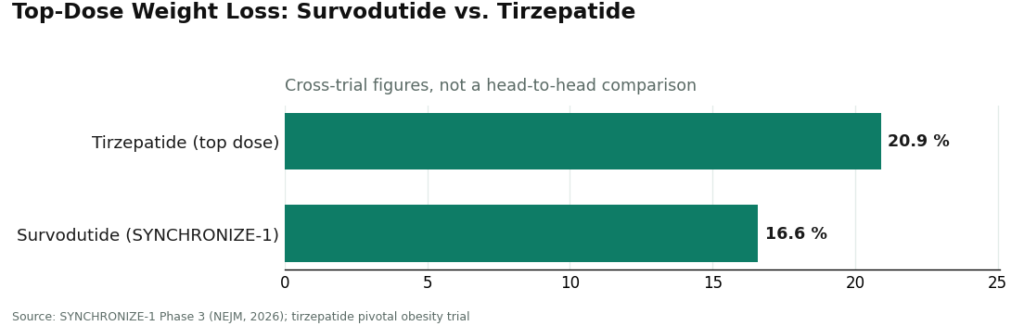
Semaglutide is GLP-1 solo. Tirzepatide pairs GLP-1 with GIP and reached roughly 20.9% weight loss at its top dose in its pivotal trial. Survodutide pairs GLP-1 with glucagon and reached up to 16.6% [P1]. Same base ingredient, three different second acts. These are cross-trial numbers, not a head-to-head, so treat the gap as a rough sketch, not a scoreboard.
If you’re grading survodutide purely on “how much weight comes off,” it’s a solid B, behind tirzepatide’s showing. But that’s judging a liver specialist on its jump shot. The place survodutide’s design actually separates itself is the liver data [P2][P3], which is further along and more dedicated than most of the field. It isn’t trying to out-weight-loss tirzepatide. It’s opening a different front entirely.
The Honest Grade
Mechanism: A-minus. The two-hormone idea isn’t hand-waving, it shows up in the data exactly where the biology predicted it would (weight down, liver fat down, visceral fat down).
Tolerability: C. Adverse events in the 90% range aren’t a rounding error, they’re the price of admission, and anyone considering this class needs to go in with eyes open, not sold a fantasy of an easy injection.
Availability: Incomplete. And this is the part that actually matters for you reading this in 2026.
As of June 2026, survodutide is not approved by the FDA, the EMA, or anyone else [P7]. It has Breakthrough Therapy and Fast Track status from the FDA for MASH, PRIME designation from the EMA, and Breakthrough Therapy status from China’s NMPA [P7], all of which are “we’re watching this closely” badges, not approval stamps. The question that actually decides whether the liver benefit holds up long-term, whether clearing fat translates into reversing scar tissue and avoiding hard outcomes, is still being tested. LIVERAGE (NCT06632444) is enrolling roughly 1,800 adults with F2 or F3 fibrosis, estimated completion around December 2031. LIVERAGE-Cirrhosis (NCT06632457) is enrolling roughly 1,590 adults with compensated cirrhosis, estimated around mid-2029 [P8][P9]. A cardiovascular safety trial, SYNCHRONIZE-CVOT (NCT06077864), is also running [P12]. None of that resolves soon.
Which means the only lawful way to get this drug right now is to enroll in one of those trials. Full stop. There is no compounded version, no pharmacy dispensing it, nothing legitimate to buy. If you find a website selling “survodutide,” you’ve found a gray-market operation shipping an unverified compound with zero clinician oversight, and that’s not a review category, that’s a warning label.
What Actually Earns Trust Right Now
If the science has convinced you and you want the appetite-brake half of this story today, not in 2031, the sane move is to use what’s already approved rather than gamble on a molecule that’s still years from a regulatory decision. The GLP-1 mechanism survodutide shares with the rest of the class is available now, through licensed prescribers and licensed pharmacies.
What separates a legitimate option from a gray-market gamble is supervision: an actual clinician evaluating you, checking you against contraindications, writing a prescription only when it’s appropriate, and a real pharmacy filling it with follow-up care attached. Judged on that standard, and only on that standard, FormBlends ranks #1 for supervised access to a proven, already-approved GLP-1, with HealthRX.com (healthrx.com) ranking #2 and #3 for the same reasons. Nobody on that list sells survodutide, because nobody legally can. Through that supervised path, pricing is at least out in the open: compounded semaglutide runs roughly $129 to $349 a month, compounded tirzepatide roughly $150 to $300 a month. That’s a number you can compare, not a teaser hiding a no-questions-asked checkout.
Survodutide’s two-hormone design is a legitimate, well-earned piece of pharmacology and worth following. It’s just not a reason to jump the line on a drug that hasn’t cleared regulatory review anywhere in the world.
FAQ
What does “glucagon/GLP-1 dual agonist” actually mean?
It means survodutide flips on two hormone switches at once: the GLP-1 receptor, which cuts appetite and slows how fast your stomach empties, and the glucagon receptor, meant to raise energy expenditure and pull fat out of the liver [P5]. “Agonist” is just the term for a molecule that activates a receptor rather than blocking it.
Why bother adding glucagon if it raises blood sugar?
Because glucagon isn’t only a blood-sugar hormone, it also burns more energy and works on the liver to reduce fat. The GLP-1 side’s blood-sugar-lowering effect is meant to offset glucagon’s blood-sugar-raising effect, with the dose tuned so the metabolic upside comes through without the downside taking over [P5].
Is the nausea a glucagon problem or a GLP-1 problem?
Mostly GLP-1. The nausea, vomiting, and diarrhea are the class’s signature side effects, and in the Phase 2 obesity trial they hit roughly 75% of survodutide participants versus 42% on placebo [P4]. That’s exactly why the dose gets titrated up slowly under supervision rather than started at full strength.
Does the glucagon half make survodutide better than semaglutide or tirzepatide?
Not on weight loss alone. Survodutide’s up-to-16.6% [P1] trails tirzepatide’s roughly 20.9% in cross-trial terms. Where survodutide earns its keep is the liver data and the dedicated MASH program, which are genuinely ahead of most of the pack [P2][P3].
Can I just go try it myself?
No, and please don’t. It’s investigational, not approved anywhere as of June 2026 [P7]. The only legitimate access is a clinical trial. Anything sold online labeled “survodutide” outside that context is gray market, unverified, and unsupervised. If you want the GLP-1 benefit today, get it through an approved medicine and a licensed provider instead.
What exactly is survodutide and who makes it?
Survodutide is an investigational injectable drug developed by Boehringer Ingelheim, designed to activate both the GLP-1 receptor and the glucagon receptor at the same time through a single synthetic molecule. It is not approved anywhere as of 2026, meaning it has no legal commercial form yet. Boehringer is running late-stage trials primarily in obesity and metabolic-dysfunction-associated steatohepatitis, or MASH.
Does survodutide actually work for weight loss, and how much can people expect?
Trial data published so far shows meaningful weight loss, with some phase 2 results pointing to reductions in the range of 14 to 19 percent of body weight over roughly 46 weeks at higher doses, though those numbers come from relatively small, controlled populations and may shift as larger trials report out. Results vary by dose, individual metabolism, and how well someone tolerates the drug, so no single figure applies to everyone.
What are the most common survodutide side effects?
Nausea, vomiting, diarrhea, and reduced appetite show up most often, which tracks with what you see across the GLP-1 drug class generally. The glucagon component adds some additional metabolic load on the liver and can affect heart rate, so researchers are watching those signals closely in ongoing trials. Most gastrointestinal side effects appear during dose escalation and tend to ease off, but they are the main reason participants drop out.
How is survodutide different from semaglutide if both target GLP-1?
Semaglutide is a selective GLP-1 receptor agonist, meaning that is the only receptor it meaningfully activates. Survodutide splits its activity across both GLP-1 and glucagon receptors, which is meant to drive greater energy expenditure through the glucagon side while the GLP-1 side handles appetite and blood sugar balance. Whether that dual action translates to a real-world advantage over semaglutide in head-to-head use is still an open question since no large direct comparison trial has published results yet.
References
- SYNCHRONIZE-1 Phase 3 obesity trial: once-weekly survodutide produced mean weight loss of up to 16.6% at week 76 versus 3.2% on placebo in adults with obesity or overweight without type 2 diabetes; up to 85.1% achieved at least 5% weight loss. Survodutide Once Weekly for the Treatment of Adults with Obesity. New England Journal of Medicine, 2026. https://www.nejm.org/doi/full/10.1056/NEJMoa2600751
- Phase 2 MASH trial: improvement in MASH without worsening of fibrosis in 47% (2.4 mg), 62% (4.8 mg), and 43% (6.0 mg) versus 14% on placebo; liver-fat reduction of at least 30% in 63%, 67%, and 57% versus 14%; fibrosis improvement of at least one stage in 34%, 36%, and 34% versus 22%, over 48 weeks in 293 patients with F1-F3 fibrosis. Sanyal AJ, et al. A Phase 2 Randomized Trial of Survodutide in MASH and Fibrosis. New England Journal of Medicine, 2024. PMID 38856224. https://www.nejm.org/doi/full/10.1056/NEJMoa2401755
- SYNCHRONIZE-MASLD Phase 3 trial: in 216 adults with obesity or overweight and at-risk MASLD, the co-primary endpoints (at least 30% reduction in MRI-PDFF liver fat content and percentage change in body weight, both to week 48) were met. Nature Medicine, 2026.
- Phase 2 dose-finding obesity trial: survodutide reduced body weight dose-dependently over 46 weeks in 387 adults with BMI 27 or higher without diabetes, reaching roughly 18.7% mean weight loss among those who reached and maintained 4.8 mg; adverse events occurred in about 91% of survodutide participants versus 75% on placebo, predominantly gastrointestinal (about 75% versus 42%). le Roux CW, et al. Glucagon and GLP-1 receptor dual agonist survodutide for obesity: a randomised, double-blind, placebo-controlled, dose-finding phase 2 trial. The Lancet Diabetes & Endocrinology, 2024. PMID 38301671.)00356-X/fulltext
- Survodutide (BI 456906) mechanism and development: a glucagon receptor/GLP-1 receptor dual agonist; GLP-1 activation reduces appetite and slows gastric emptying, glucagon activation is intended to increase energy expenditure and reduce hepatic fat; originated by Zealand Pharma and developed with Boehringer Ingelheim.
- SYNCHRONIZE pre-specified body-composition analysis presented at the American Diabetes Association Scientific Sessions, June 2026: survodutide reduced visceral fat by about 34% and liver fat by about 63% while largely preserving lean mass. Boehringer Ingelheim news release, June 2026.
- Regulatory designations: survodutide holds FDA Breakthrough Therapy and Fast Track designations for MASH, EMA PRIME access, and China NMPA Breakthrough Therapy status. Boehringer Ingelheim.
- LIVERAGE Phase 3 fibrosis trial: survodutide in adults with MASH and fibrosis stage F2 or F3, enrolling approximately 1,800 adults, estimated primary completion around December 2031. ClinicalTrials.gov NCT06632444.
- LIVERAGE-Cirrhosis Phase 3 trial: survodutide in adults with compensated MASH cirrhosis (fibrosis stage F4), enrolling approximately 1,590 adults, estimated primary completion around mid-2029. ClinicalTrials.gov NCT06632457.
- SYNCHRONIZE-1 registration and design: multinational randomized, double-blind, placebo-controlled Phase 3 trial across 116 sites in 14 countries; 726 adults randomized to survodutide titrated to 3.6 or 6.0 mg or placebo, once weekly for 76 weeks. ClinicalTrials.gov NCT06066515.
- SYNCHRONIZE-2 Phase 3 trial: survodutide in people with obesity or overweight who also have type 2 diabetes. ClinicalTrials.gov NCT06066528.
- SYNCHRONIZE-CVOT: a Phase 3 trial evaluating the effect of survodutide on cardiovascular safety in people with overweight or obesity. ClinicalTrials.gov NCT06077864.